Mark Emelianov
EN

Presentation · AI World

A world of agents that works and stays compliant.

Many AI agents, many hosts, many people: it only holds together if every consequential action is gated, isolated and leaves evidence.

How such a world is built to work, and how the same building blocks answer what ISO 27001, the EU AI Act and similar frameworks ask for.
01

The picture

Four layers, one rule

Every layer assumes the agent above it can be wrong, and limits what a mistake can reach.

  1. PeopleOwn the decisions: approve merges, set scope, accept risk.
  2. AgentsDo the work in separate loops with measurable progress rules.
  3. Hosts and platformsSmall, isolated, allow-listed: no inbound port, signed messages.
  4. EvidenceEvery step leaves a record that an auditor can follow.
Trust zones of an agent world Three zones left to right: an agent sandbox with limited credentials, a gate with review, scan and owner approval, and the shared core. Below, small hosts reached only through allow-listed commands and signed messages with no inbound port. An evidence band underneath records every crossing. Sandboxagents work herelimited credentialsno way out by itself Gateindependent reviewmarker scanowner approval Shared corechanges arrive branch by branchone instance per organisation Small hosts: allow-listed commands, signed messages, no inbound port Evidence: every crossing leaves a record someone else can follow
Figure: trust zones of an agent world, drawn in roles only.

02

Make it work

Hard controls, not good intentions

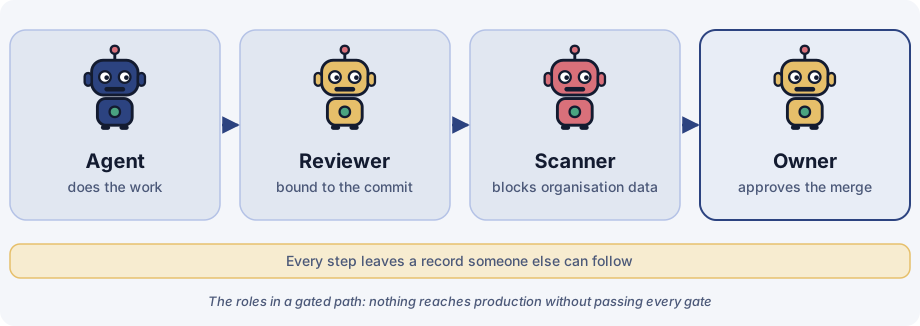
Four robots as roles in a gated path: agent does the work, reviewer is bound to the commit, scanner blocks organisation data, owner approves the merge. Every step leaves a record someone else can follow.
Figure: the roles in a gated path, drawn as robots.
The gated path from agent work to production Five steps in a row: an agent works on a branch, an independent review bound to the exact commit, a marker scan that blocks organisation data, the owner approves the merge, and every step leaves a record. Agentworks on a branch Reviewbound to the commit Scanblocks org. data Ownerapproves the merge Recordevidence kept Nothing reaches production without passing every gate Every arrow assumes the step before it can be wrong
Figure: the gated path from agent work to production.

Topic: running agents without drift → Topic: hard controls →

03

Make it compliant

The same controls, read as evidence

Compliance is not a second system: the gates and records that make the world work are what auditors ask to see.

Which building block answers which expectation (indicative: ISO 27001:2022 Annex A, SOC 2 criteria, and the EU AI Act for high-risk systems by analogy)
Building blockWhat it evidencesFramework hooks
Owner-approved mergeA human decides before change goes liveISO 27001 change management; an oversight pattern comparable to EU AI Act human oversight (high-risk systems); NIST AI RMF Govern
Independent review bound to a commitSeparation of duties; what was reviewed is what shippedISO 27001 secure development; SOC 2 change management
Isolation and allow-listsLeast privilege; limited blast radiusISO 27001 access control and configuration management; SOC 2 logical access
Signed messages and logsTraceability of who did what, whenISO 27001 logging; comparable to EU AI Act record-keeping (high-risk systems)
Risk register and task trackingKnown risks have owners and datesISO 27001 risk treatment; ISO/IEC 42001 AI management system; NIST AI RMF Map and Manage
Readiness trackingGaps against the EU AI Act and Cyber Resilience Act are visible earlyEU AI Act; EU Cyber Resilience Act

Hooks are indicative, not a certification claim or legal advice. Check clause numbers and application dates against the current texts before relying on them.

04

How to start

Five steps

  1. Map it

    List every agent, host and platform, and what each can touch. You cannot govern what you cannot see.

  2. Isolate it

    Limited credentials, sandboxes, allow-lists. Assume any agent can be wrong or manipulated.

  3. Gate it

    Independent review and an owner approval before anything leaves the sandbox.

  4. Record it

    Make evidence a by-product: signed messages, commit-bound reviews, task history.

  5. Map to frameworks

    Link each control to the expectation it answers, track readiness, and review on a rhythm.

Read the articles → Who is behind this → Work with me →